Research / 01 / Contextual learning
KGPFN
Learning from graph context.
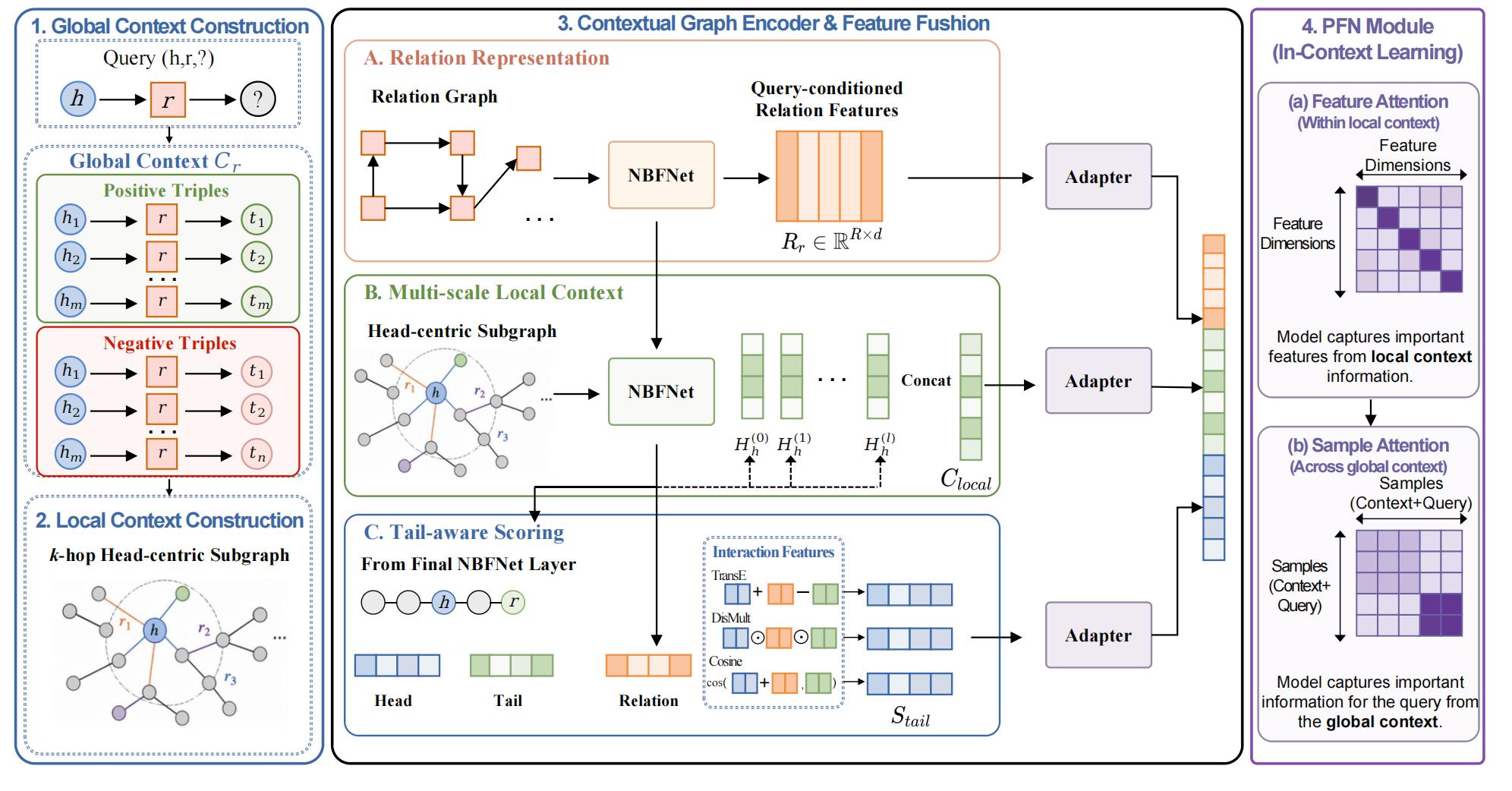
KGPFN combines local neighbourhoods, relation patterns and example triples to predict missing links through in-context learning.
The research
What this work contributes.
A model trained on one knowledge graph may struggle with new entities or relation types. KGPFN addresses this by conditioning predictions on examples from the target graph, adapting at inference time without updating its parameters.
The method
How it works.
Build the context
Gather examples of the queried relation and the neighbourhood around each head entity.
Encode the structure
Combine relation representations, local graph features and candidate-tail interaction signals.
Predict through examples
A prior-data fitted network attends across features and examples to rank possible missing links.
Evaluated across 57 graph benchmarks
The authors report strong transfer to unseen graphs through in-context learning, outperforming competitive fine-tuned baselines in inductive and fully inductive settings.
Explore the studyConnection to finance
From research to financial intelligence.
Financial information is relational: issuers, subsidiaries, instruments and suppliers connect across many datasets. Context-sensitive link prediction suggests a way to investigate gaps in those connections.
Issuer and counterparty research
Rank candidate relationships between companies, securities and counterparties for an analyst to verify against filings and source records.
Adapting to a new coverage universe
Use examples from a new sector or regional dataset to guide relationship discovery when its entities and relation vocabulary differ from existing coverage.
Which supplier relationships might be missing from our coverage of this issuer?
An illustrative workflow would combine the issuer’s known neighbourhood with examples of supplier links, then return candidates for document review. These candidates would be research leads, with confirmed links stored separately.
These potential applications are our interpretation of the method. Financial outcomes are not evaluated in the cited work.
Paper & resources
Read the original work.
KGPFN: Unlocking the Potential of Knowledge Graph Foundation Model via In-Context Learning14 May 2026 · Research preprint