
Research / 03 / Neural graph reasoning
Neural Graph Reasoning
Queries in graph and vector space.
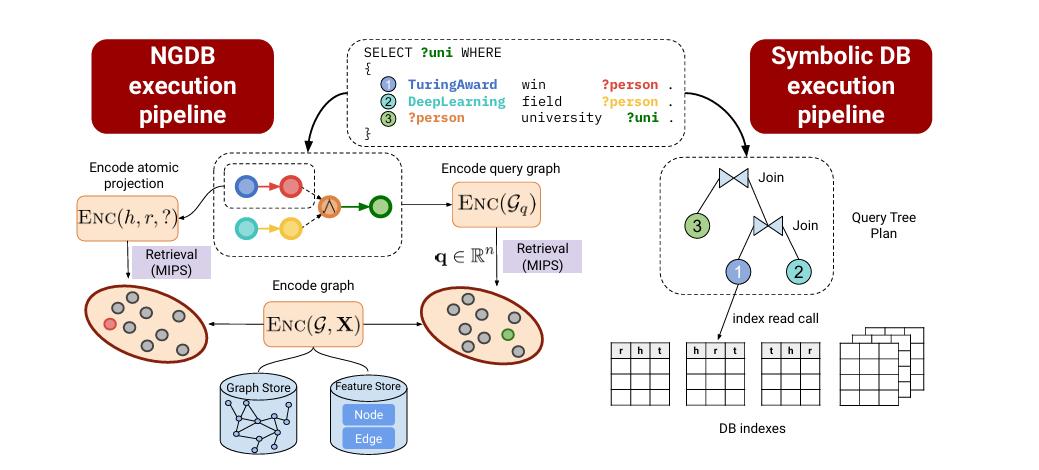
A neural graph database encodes graph structure and queries into embedding space. The figure compares this path with symbolic database execution.
The research
What this work contributes.
Complex logical query answering goes beyond predicting one missing link. This survey organises methods for reasoning over multiple relationships in incomplete graphs and introduces the Neural Graph Database concept, combining graph storage with learned query execution.
The method
How it works.
Represent the knowledge
Store graph connections and node or edge features alongside learned vector representations.
Plan the query
Break a structured question into relationship traversals and logical operations.
Retrieve possible answers
Execute over learned representations to recover candidates even when some graph connections are missing.
A framework for reasoning over incomplete graphs
The contribution is a survey, taxonomy and database design agenda. Figure 7 explains neural and symbolic execution; it is not a benchmark of a deployed financial database.
Explore the studyConnection to finance
From research to financial intelligence.
Financial questions often span several entities and conditions. Connecting holdings to issuers, subsidiaries and business relationships makes graph reasoning relevant to research and exposure analysis.
Portfolio exposure discovery
Explore paths from portfolio instruments to issuers and business partners to identify potential indirect exposures for further investigation.
Research with multiple conditions
Combine relationships and filters, such as holdings issued by companies connected to a particular sector and geography, within a structured research query.
Which holdings may be connected to a disruption through their issuers’ suppliers?
An illustrative query would traverse holding, issuer and supplier relationships, returning known paths and inferred candidates with distinct labels. Confirmed records and position data would then support the exposure calculation.
These potential applications are our interpretation of the method. Financial outcomes are not evaluated in the cited work.
Paper & resources
Read the original work.
Neural Graph Reasoning: Complex Logical Query Answering Meets Graph Databases26 March 2023 · Survey & research framework